Is carbon black organic or inorganic? PMU ink pigments explained
The “organic carbon black” myth: it looks like benzene, but is built from graphene sheets with no C–H bonds, making it an inorganic pigment in PMU inks.

There is an opinion that Carbon Black pigment can be either organic or inorganic and that it all depends on the method of its production: allegedly, Carbon Black obtained by burning petroleum products is organic, while Carbon Black obtained by burning gas is inorganic (or vice versa, it does not matter). It’s time to put an end to this debate and provide evidence that Carbon Black is an inorganic pigment! Let’s go!
Where did this myth that Carbon Black pigment is supposedly organic come from in the first place? Most likely from a misinterpretation of the definition of organic matter:
“Organic compounds, organic substances – a class of chemical substances that unites almost all chemical compounds that include carbon atoms bonded to atoms of other chemical elements.”
Wikipedia
I draw your attention to the wording “that include carbon atoms”, not carbon itself! The structure of Carbon Black pigment also adds fuel to the fire – look at its molecular structure!
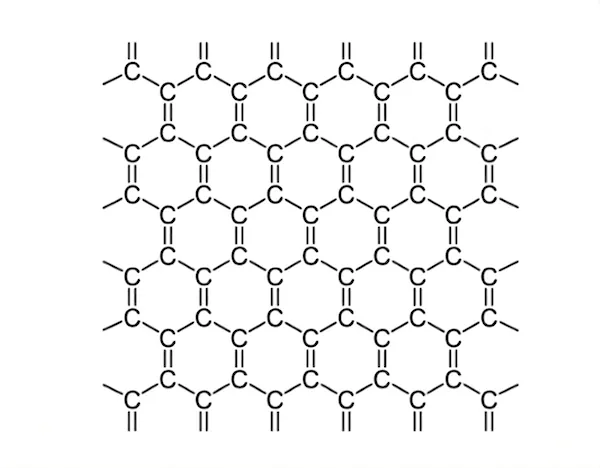
Chemical structure of Carbon Black pigment
Now look at the structure of a classic organic molecule – benzene:
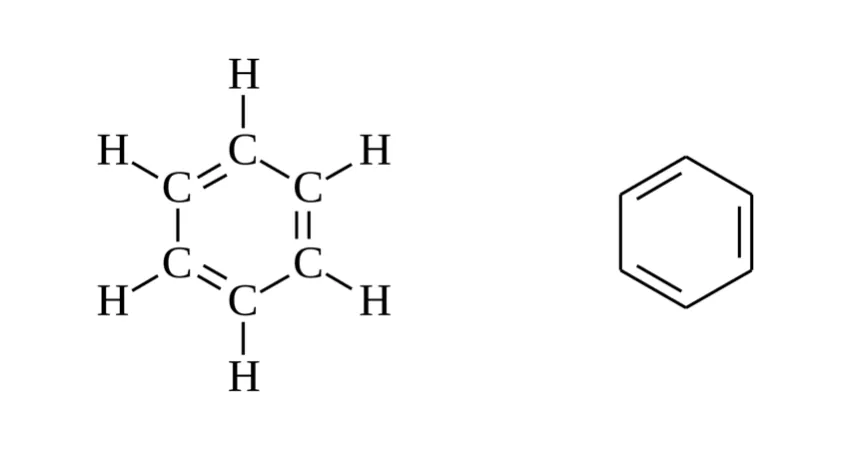
Chemical structure of the organic molecule benzene
They are very similar, and I think that this also influenced the myth that Carbon Black pigment is organic. However, there is a very important difference in the structure. In essence, Carbon Black particles are formed from layered sheets of graphene.
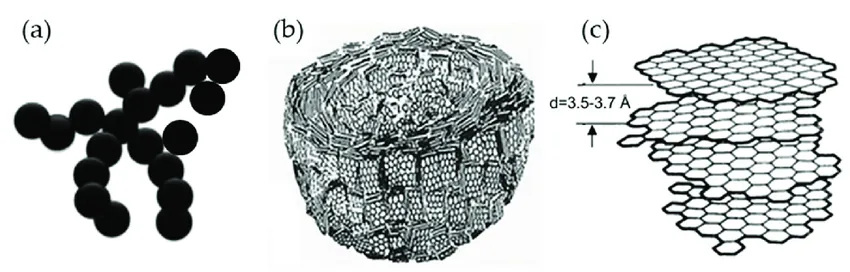
Image source: Shen, Ming-Yuan, Wen-Yuan Liao, Tan-Qi Wang, and Wei-Min Lai. “Characteristics and Mechanical Properties of Graphene Nanoplatelets-Reinforced Epoxy Nanocomposites: Comparison of Different Dispersal Mechanisms”. https://doi.org/10.3390/su13041788.
Carbon Black particles can be described as aggregates and agglomerates of graphene-like sheets (c). These sheets, which are essentially small fragments or stacks of graphene-like structures, are layered and intertwined to form spheroidal formations (b) called “primary particles”. These primary particles then combine to form chain-like structures or aggregates (a).
Graphene is considered an inorganic material. It consists of a single layer of carbon atoms arranged in a hexagonal lattice. Although carbon is a fundamental element in organic chemistry, graphene itself is not based on the carbon–hydrogen (C–H) bonds that are characteristic of organic compounds. Instead, the structure of graphene is based on carbon–carbon (C–C) bonds.
At this point, I propose to close the discussion on whether Carbon Black is an organic or inorganic pigment. As for how understanding the structure and properties of Carbon Black matters for both permanent makeup application and laser tattoo and PMU removal, we will talk about that in other articles!
Frequently asked questions
Is carbon black an organic or inorganic pigment?
Inorganic. Carbon black particles are aggregates of graphene-like sheets, and graphene is built on carbon–carbon bonds, not on the carbon–hydrogen bonds characteristic of organic compounds.
Why do some people think carbon black is organic?
Most likely from a misreading of the definition of organic compounds, which include carbon atoms bonded to other elements, and from the similarity of its structure to the organic molecule benzene.