Your PMU is in danger! How sun and UV fade tattoos
Why tattoos and PMU fade in the sun: UV breaks down pigment. What lightfastness ratings (Blue Wool, ASTM) mean and how SPF sunscreen protects the colour.

The loud headline of this article is true :)
Let me start from afar. Once on holiday, walking around the hotel grounds, I came across a "Wet floor" sign. Later I came across it again — and by then it had faded badly!
You can compare for yourself:
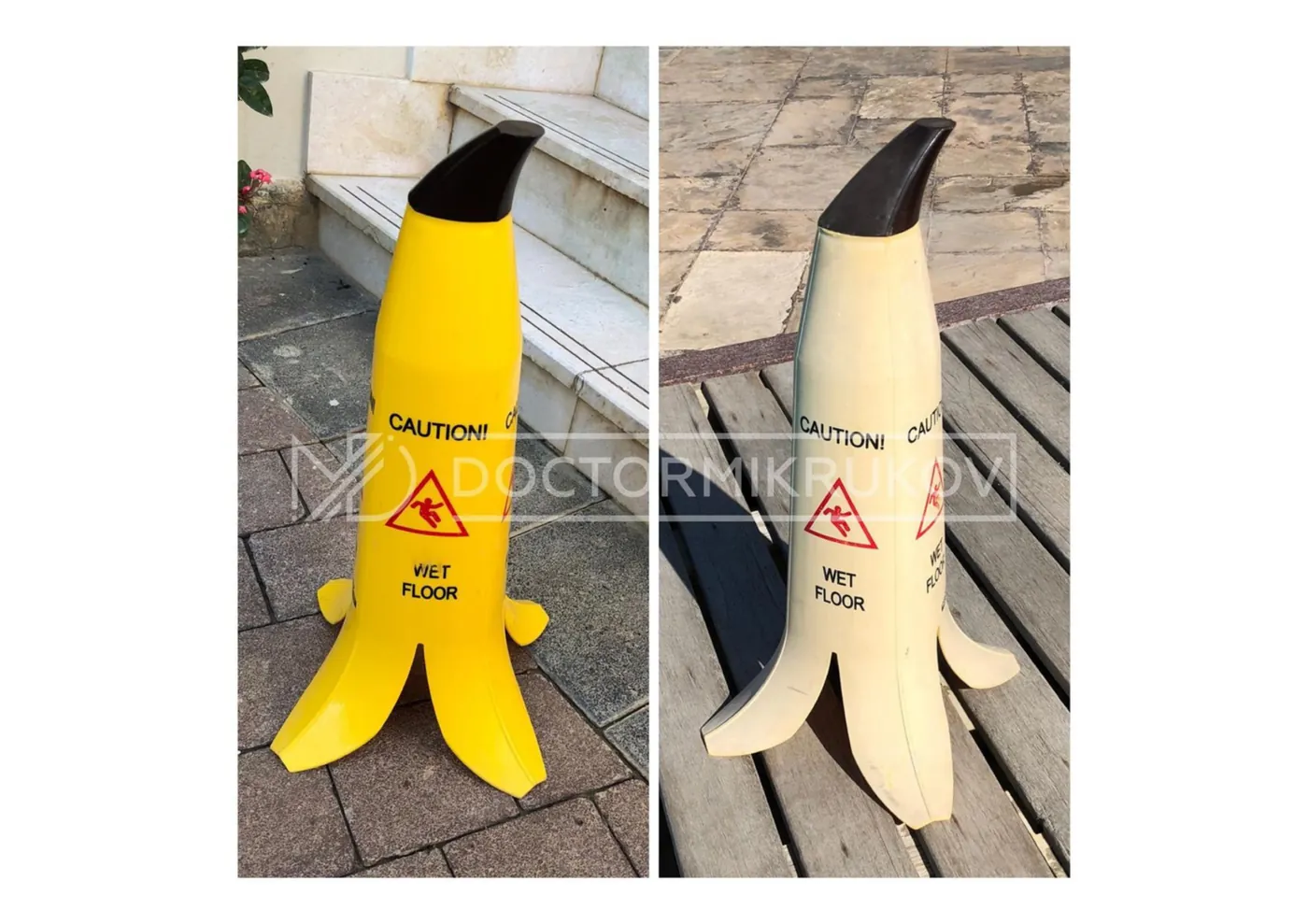
Notice how much the paint on the plastic has faded!
When a person spends a long time in the sun, does pigment fade in the same way?
Yes. Under the influence of solar radiation, tattoos and PMU (permanent makeup) fade.
Add to this the work of the immune system, which actively removes small ink particles from the body. Part of the pigment is broken down and removed from the skin by macrophages.
Changes to your tattoo or PMU are inevitable, and to keep them bright you need to protect yourself from UV light.
Among the important characteristics of artificial pigments (organic and inorganic), I would single out lightfastness. It shows how resistant an ink is to being broken down by UV light. This factor is measured on several scales.
How do you measure a pigment's lightfastness?
There is no lightfastness table specifically for PMU and tattoo pigments yet. But as an example, I have prepared a table describing different degrees of resistance of colouring substances.
The Blue Wool rating is a lightfastness table for colouring substances (colorants). The system was originally developed for dyeing textiles, but it is now applied to other colorants too.
The ASTM rating is a standard of the American Society for Testing and Materials.
| Description | Blue Wool rating | ASTM rating | Direct sun: summer | Direct sun: winter | Durability under normal conditions |
|---|---|---|---|---|---|
| Very poor lightfastness | 1 | V | — | — | less than 2 years |
| Poor lightfastness | 2 | IV | — | — | 2–15 years |
| Poor lightfastness | 3 | IV | 4–8 days | 2–4 weeks | 2–15 years |
| Fair lightfastness | 4 | III | 2–3 weeks | 2–3 months | 15–50 years |
| Fair lightfastness | 5 | III | 3–5 weeks | 4–5 months | 15–50 years |
| Very good lightfastness | 6 | II | 6–8 weeks | 5–6 months | 50–100 years |
| Excellent lightfastness | 7 | I | 3–4 months | 7–9 months | more than 100 years |
| Excellent lightfastness | 8 | I | more than 1.5 years | more than 1.5 years | more than 100 years |
Disclaimer: there are many myths and a lot of unreliable information around PMU and tattoo pigments. I am not prepared to divide particular pigments into "good" and "bad".
I am in favour of reliable scientific data and of expanding your competence in this area :)
What can you do so that a tattoo or PMU does not fade quickly?
The main thing is to buy a good-quality sunscreen with a high SPF. Apply it regularly whenever you are in the sun. Ideally, the tattoo or PMU area should be kept in the shade (under a cap, a hat, etc.).
And if a tattoo or PMU has already faded, it can be refreshed with a touch-up.
Frequently asked questions
Does the sun fade tattoos and PMU?
Yes. Under solar radiation tattoos and PMU fade, and the immune system also removes small ink particles from the skin. How resistant an ink is to UV depends on its lightfastness.
How do you keep a tattoo or PMU from fading in the sun?
Use a good-quality sunscreen with a high SPF and apply it regularly whenever you are in the sun; ideally keep the area in the shade, under a cap or hat. A tattoo or PMU that has already faded can be refreshed with a touch-up.
How is pigment lightfastness measured?
There is no lightfastness table specifically for PMU and tattoo pigments yet. Colorants are rated on scales such as Blue Wool, originally developed for textiles, and the ASTM rating of the American Society for Testing and Materials.