Why do tattoos fade unevenly after laser removal?
Why tattoos and PMU fade unevenly under the laser: uneven pigment density, inconsistent work by the artist and lower fluence on densely packed areas.
Common misconceptions about laser tattoo removal
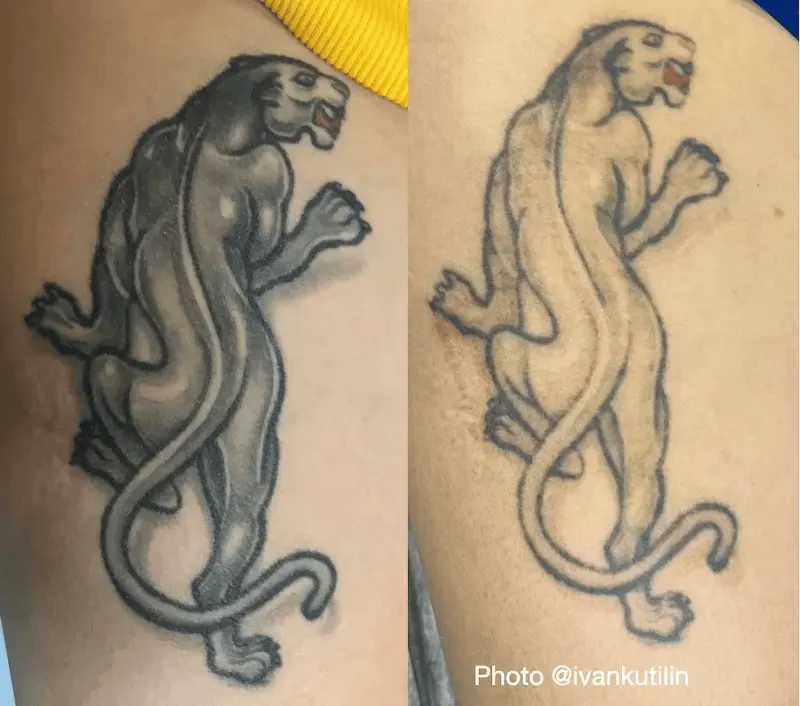
Clients are often confused by the fact that tattoos disappear unevenly: some parts disappear quickly, while others take a long time and require additional sessions! Why does this happen? Who is to blame, and what should we do?
Reasons why tattoos are removed unevenly by laser
The main reason why tattoos (and permanent makeup, by the way, too) can be removed unevenly is that they are not evenly applied. On the one hand, this is intended by the design of the tattoo: some parts are more densely filled (such as the contour or individual darker elements), and some parts are less densely coloured (such as soft transitions, shadows, and blending). That is, the amount of tattoo pigment in different parts of the skin will be different.
How many sessions will it take?
A quick estimate on the Kirby-Desai scale — for tattoos.
10 sessions, approximately
A rough estimate. More on the Kirby-Desai scale page.
The human factor and uneven application of pigment
The second reason is the human factor: the artist simply colours various parts of the skin unevenly, although in theory they should be technically identical. Perhaps it seemed to the artist that an area was not coloured enough, so they went over it once more, or they simply got lost in thought and worked on one area longer than on the others. As a result, the whole tattoo is a structure that is heterogeneous in the amount of tattoo pigment introduced into the skin.
Unevenness of laser tattoo treatment
Now, let’s look at the uniformity of the laser treatment. This is also a very creative process, and the specialist changes the parameters of energy density in the treatment of different areas of the tattoo depending on the specific situation. The most interesting thing is that in areas where the tattoo is less densely coloured and there is little pigment, you can safely use higher parameters of energy density and not be afraid of complications.
But where there is a lot of pigment and, logically, a stronger impact is needed to achieve results, you need to temper your ardour and treat more gently, because the risk of complications in such areas is much higher. This, by the way, is a typical mistake of an inexperienced laser removal specialist: they try to treat the more densely packed areas of the tattoo more aggressively and, naturally, get complications.
Conclusion: why tattoos are removed unevenly by laser
The result is a twofold situation: the more densely filled areas initially contain more tattoo pigment, and on top of that, the energy density has to be reduced during laser treatment to avoid complications. Therefore, at the initial consultation, after a careful examination of the tattoo, a laser removal professional can immediately say which areas of the tattoo will disappear first and which will lag behind and may require additional sessions. This is not a whim or a mistake of laser tattoo removal specialists but a combination of objective factors – tattoos are simply removed unevenly. Accept it.
Frequently asked questions
Why do some parts of a tattoo take longer to remove?
Densely filled areas such as the outline or darker elements contain more pigment, and on top of that the energy density has to be reduced there to avoid complications. So these areas lag behind and may require additional sessions.
Should dense areas of a tattoo be treated with higher energy?
No. Treating densely packed areas more aggressively is a typical mistake of an inexperienced laser removal specialist and leads to complications. Higher energy density can safely be used where there is little pigment.
Can you tell in advance which parts of a tattoo will fade first?
Yes. After a careful examination at the initial consultation, a laser removal professional can say which areas will disappear first and which will lag behind and may require additional sessions.