Diode hair removal laser on tattoos and PMU: what happens?
Why a diode hair removal laser must never touch tattoos or PMU: its millisecond pulse does not shatter pigment but overheats it, causing burns and scars.
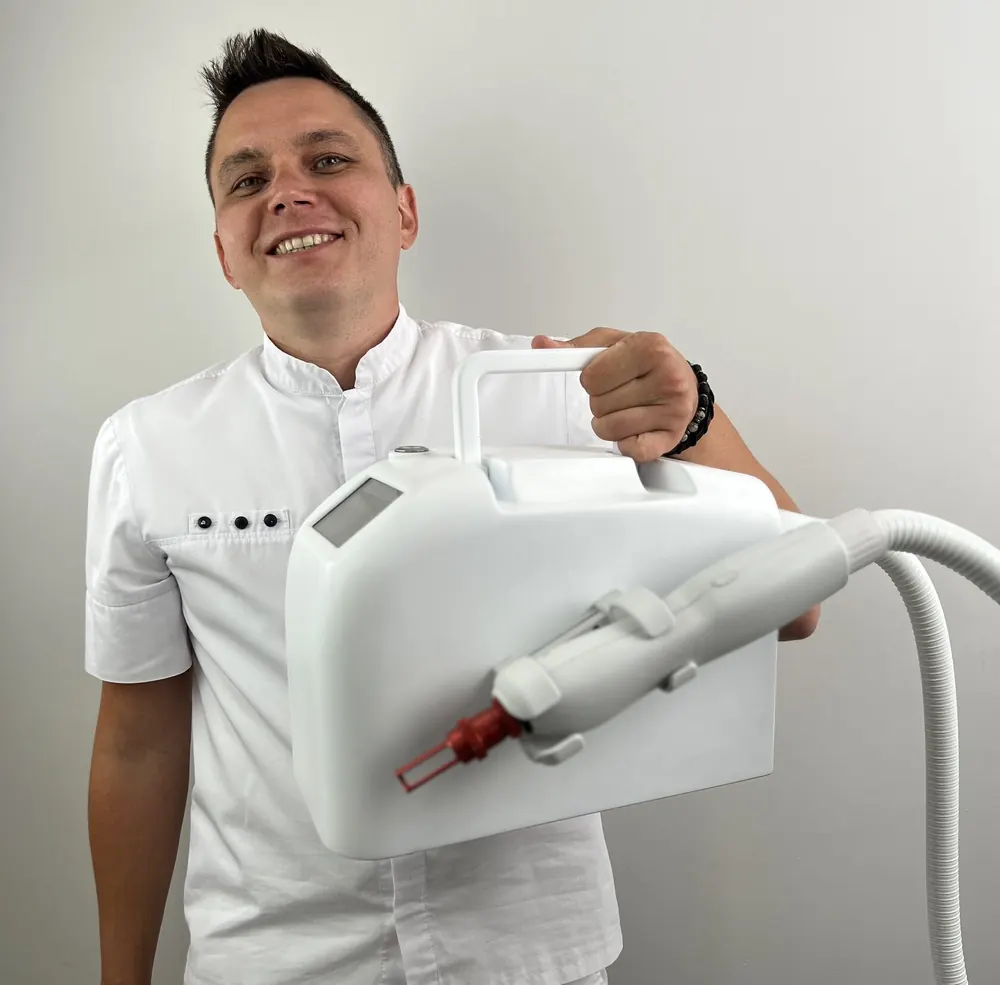
Patients come to me whose tattoo or PMU (permanent makeup) was treated with a diode laser — some by accident, some deliberately.
The diode laser is used for hair removal, and for some reason some specialists don’t know that this laser must never be used over tattooed or PMU areas!
Other specialists, for some reason, deliberately believe that this laser can remove a tattoo!
So let’s work out what the difference is and why such lasers must not be used on tattoos!
So, diode lasers used for hair removal have a wavelength of 808, 810 or 805 nanometres. Models with wavelengths of 755 and 1060 nanometres have now appeared too. All these diode lasers emit very powerful light energy at a single wavelength with a fluence (energy density) of up to 100 J/cm² or more — and that is a very high energy density; you could light campfires with lasers like these!
These wavelengths are absorbed very well by the artificial pigments of tattoos and PMU, but that doesn’t mean the removal effect will be the same as with Q-switched Nd:YAG lasers or picosecond lasers!
A diode laser’s pulse duration is measured in milliseconds. To make the difference between the abbreviations ns (nanosecond) and ms (millisecond) clear, here is how they relate: one millisecond is a million nanoseconds. That is a fundamental difference, and these laser pulses simply cannot be compared!
What happens when a diode laser hits PMU or a tattoo?
The pulse duration of such a laser is millions of times longer than the thermal relaxation time of artificial pigment particles. This means the pigment particles simply transfer this energy to the tissue and heat up, but they are not actually shattered!
The pigment particles become red-hot and pass the energy on to the surrounding skin tissue, which leads to overheating and severe skin burns!
So if you are a specialist, please take note of this important fact: diode lasers must never be used on tattoos or PMU!
It’s best not even to get too close to areas with artificial pigment, to rule out accidental exposure!
If you are a patient, please tell your specialist that you have tattoos and where, or that you have PMU, so that during the procedure they never pass over these areas with the laser hair removal device, not even by accident!

One of the cases is a patient to whom the specialist deliberately suggested:
“How about I go over your tattoo with the laser a couple of times during hair removal and lighten it while we’re at it!”
This is exactly where the problem lies: a severe burn forms at that spot, and what the outcome will be there — a scar, a pigmentation disorder or some other visible mark — depends on how the healing and tissue repair go!
So I strongly urge specialists to understand the technology, parameters, methods of action and limitations of the equipment you use.
And I urge patients to be vigilant and to choose quality equipment and genuine specialists in laser cosmetology who understand what they are doing and are not random people in the industry!
Which device removes a tattoo?
Pick a device and fire a pulse at the pigment particles.
Pigment shatters only when the energy arrives faster than the particle's thermal relaxation time. Based on the article on four devices that cannot remove tattoos.
Frequently asked questions
Can a diode hair removal laser remove tattoos?
No. Its pulse duration is measured in milliseconds, millions of times longer than the thermal relaxation time of pigment particles, so the pigment heats up instead of being shattered and passes the energy to the surrounding skin, causing overheating and severe burns.
What happens if laser hair removal goes over a tattoo or PMU?
A severe burn forms at that spot, and whether it ends in a scar, a pigmentation disorder or another visible mark depends on how healing goes. Patients should tell the specialist where their tattoos or PMU are so the device never passes over them, not even by accident.