How to tell a real picosecond laser from a fake
Picosecond laser machine price: a genuine unit costs about $200,000, fakes $5–55k. What is inside a cheap “picosecond pen” and what to check before you pay.
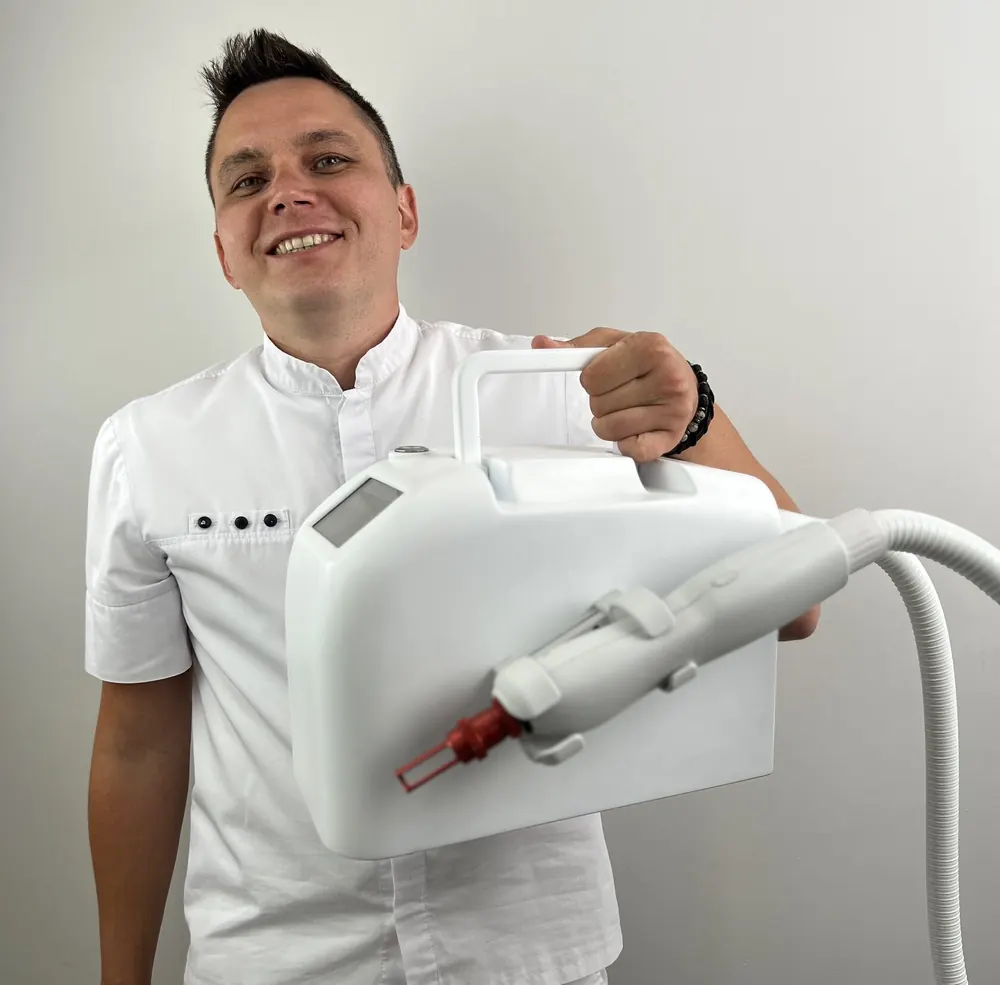
A colleague once showed me a laser she had just bought. It looked like a picosecond system, it was sold as a picosecond system, and its manual settings did nothing at all. The device was a fake. She found out after paying for it.
This market is full of such machines, and the people buying them are not careless — they are specialists who were never told what the real numbers look like. So let us go through them.
The price already tells you most of it
A genuine licensed picosecond laser costs 14–16 million roubles — roughly $200,000. That is the real cost of the technology: the optics, the licensing, the engineering behind a pulse measured in trillionths of a second.
Counterfeit and pseudo-picosecond devices are sold for $5,000 to $55,000. The gap is not a discount, and it is not a clever supplier who cut out the middleman. Physics does not go on sale. If a device is offered as picosecond for a fraction of the real price, the honest assumption is that it is not one.
What is actually inside a cheap “picosecond pen”
At the bottom of this market sit the handheld “picosecond laser pens” — devices promising two wavelengths, tattoo removal, wrinkle treatment and pigmentation lightening for the price of a dinner. I opened one.
- a small laser diode
- an ineffective lens
- a cooling fan with two wires
That is the entire device. There is no Q-switch, no resonator capable of a picosecond pulse, nothing that could selectively destroy pigment. What such a pen can do is burn tissue — which is exactly what it does.
How short is a pulse?
Compare durations: how far light travels in that time.
Speed of light ≈ 300,000 km/s. A Q-switched Nd:YAG works with nanosecond pulses; a picosecond pulse is 1,000 times shorter.
It all comes down to peak power
The energy stays the same — change the pulse duration.
Peak power = energy ÷ pulse duration. That is why the millijoules on the display say nothing about effectiveness on their own.
The manufacturer will verify the device for you
This is the part most buyers do not know. PicoSure, as a genuine manufacturer, runs a verification programme: you can ask them to confirm whether your device is authentic. Where a counterfeit is identified, the company offers compensation for procedures already performed and pursues the sellers of the fake in court.
In other words, the check costs you nothing but an email — and it is available before you transfer the money, not only after.
Before you pay
- Verify the serial number and the device directly with the official manufacturer, not with the seller.
- Ask for the registration certificate and the import documentation. A legitimate medical device has a paper trail.
- Check every stated parameter against the manufacturer’s own specification sheet — pulse duration, energy, wavelengths, spot sizes.
- Treat every manual control as something to test, not to trust. On the fake my colleague bought, the settings were decorative.
Choose your equipment carefully and check every detail. This is your instrument and your reputation as a specialist — and unlike the machine, the reputation cannot be replaced under warranty.
The bar for fakes shows the top of the range.
- A small laser diode
- An ineffective lens
- A cooling fan with two wires
Promised: two wavelengths for tattoo removal, wrinkle and pigmentation treatment.
Frequently asked questions
How much does a picosecond laser tattoo removal machine cost?
A genuine licensed picosecond laser costs 14–16 million roubles, roughly $200,000. Counterfeit and pseudo-picosecond devices sell for $5,000 to $55,000, and if a device is offered as picosecond for a fraction of the real price, the honest assumption is that it is not one.
How do I check that a picosecond laser is genuine before buying?
Verify the serial number and the device directly with the official manufacturer, not with the seller, ask for the registration certificate and import documentation, and check every stated parameter against the manufacturer's own specification sheet. PicoSure, for example, runs a verification programme that confirms whether a device is authentic.