The Neatcell laser pen for tattoo and PMU removal: does it work?
Do laser tattoo removal pens work? Testing the Neatcell laser pen on card and a skin model: its diode burns and melts tissue, unlike a Q-switched Nd:YAG laser.
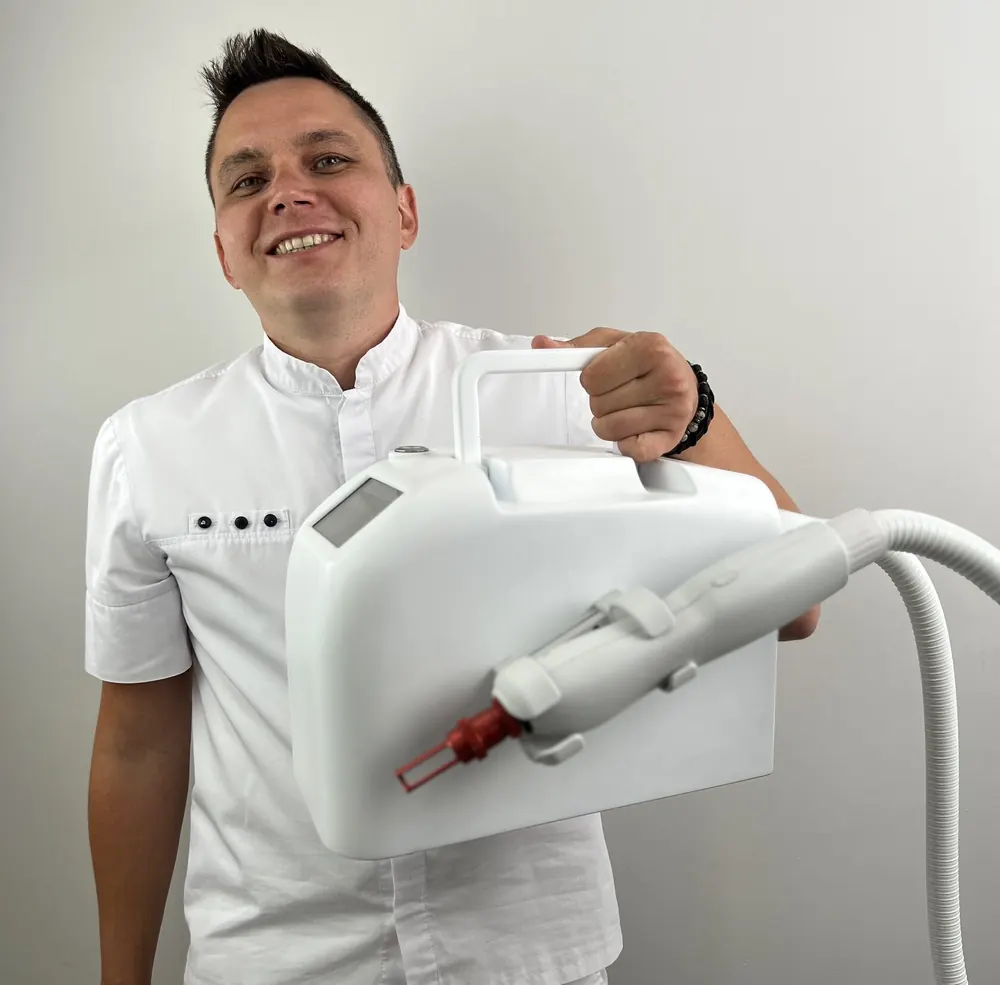

We have already made a video about this pen, and it was rather humorous. The comments, however, were far from funny: there was a flood of attacks and accusations of bias. So today we will look at the topic in more detail and find out who is right!
This time I ordered both the blue and the red pen, to avoid complaints that the blue one is useless and only the red one actually works. Both pens come with the same instructions, with no Russian translation, so I had to get the information from other video reviews. It turned out that 1 is the highest power and 9 is the lowest.
Experiment 1. Black and white cardboard
This is where we start. We take a sheet of black cardboard and set the power and frequency (Hz) to 1. We press the start button. What do we see? Surprisingly, smoke. Then we increase the power and treat the surface for a while.
Now we have a small area burned right through. This is predictable. The lens focuses the energy from the laser diode into a point, and the black colour absorbs it. It even burns through white, so selectivity is not even a question here.
We take the red pen and set 1 Hz, power 4. The pen started working on its own without the button being pressed. The result on white and on black is about the same as with the blue pen.
Experiment 2. A skin model with real tattoo ink
I take the red pen straight away, set a higher power, leave it at 1 Hz and start treating the skin model. What happens? The pigment heats up and starts burning the tissue around it; the piece of "skin" simply melts and runs. Almost the same thing happens to real skin. If you think you can remove tattoos like this without injury, I have to disappoint you. There will be massive heating, damage, blood and, later, scarring.

How short is a pulse?
Compare durations: how far light travels in that time.
Speed of light ≈ 300,000 km/s. A Q-switched Nd:YAG works with nanosecond pulses; a picosecond pulse is 1,000 times shorter.
Which device removes a tattoo?
Pick a device and fire a pulse at the pigment particles.
Pigment shatters only when the energy arrives faster than the particle's thermal relaxation time. Based on the article on four devices that cannot remove tattoos.
Experiment 3. A Q-switched Nd:YAG laser
We move to the clinic, not forgetting our old skin model. Now we will treat it properly, with a stationary Q-switched Nd:YAG laser with controlled power, optics, energy and everything else.
With the pens, by the way, it is completely unclear what wavelength, pulse duration, energy, power and other parameters are used. You have to figure it out by guesswork, somehow.
We use 3 J/cm², a 4 mm spot and 8 Hz. We treat the model and see a clear change in the pigment, but this time without the sample melting. We fragmented and broke down the pigment, as it should be when working with a Q-switched Nd:YAG laser. No injury and no damage!
Conclusion on the pen's effectiveness for tattoo and PMU removal
I looked for video reviews from people who tried these pens on themselves. A telling one was from a man who does not complain about the result — only now he has a second-degree burn and scarring on his leg. He is not bothered by it. I also saw these pens being used for carbon peeling. Zero result, but at least no injuries, because the exposure is short.
This device is based on a laser diode and is in no way designed for tattoo removal. However, I need to add a remark here. When I say "tattoo removal", I mean exclusively atraumatic removal without damage or scars. Only specialised registered devices are used for that: nanosecond and picosecond lasers.
Neatcell pens are not designed for tattoo removal; they only cause thermal damage to the skin. You could just as well remove a tattoo with a soldering iron or a children's wood-burning kit. Here the pigment is removed together with a burn.
Something honest and important
You can take a very expensive professional laser and cause exactly the same burns and injuries. It all comes down to the specialist's knowledge and experience. With proper training, tattoo removal without damage is possible.
Treat comments with scepticism, because everyone understands the result differently. For some people, removing a tattoo at the cost of a scar is fine — the main thing is that the tattoo can no longer be seen.
Everyone is free to make their own decisions about what to do with their skin. My materials are a warning to those who do not want to end up with injuries that will stay with them for life. Be careful!
Frequently asked questions
Do laser tattoo removal pens work?
In the tests, the Neatcell pens burned through black and even white card, and on a skin model with real tattoo ink the pigment heated up and the sample melted. Such pens only cause thermal damage to the skin: the pigment is removed together with a burn.
Is the Neatcell picosecond laser pen a real picosecond laser?
No. The pen is based on a laser diode, and its wavelength, pulse duration, energy and power are unknown. Removal without damage or scars is done only with specialised registered devices: nanosecond and picosecond lasers.
How does a Q-switched Nd:YAG laser compare with a laser pen?
On the same skin model, a stationary Q-switched Nd:YAG laser at 3 J/cm², a 4 mm spot and 8 Hz fragmented the pigment without the sample melting. With the pens, the pigment heated up and the model melted.