Laser and remover in one PMU removal session: yes or no?
Saline (remover) vs laser PMU removal: how each method works, what each can and cannot remove, and why combining them in one session intensifies skin trauma.
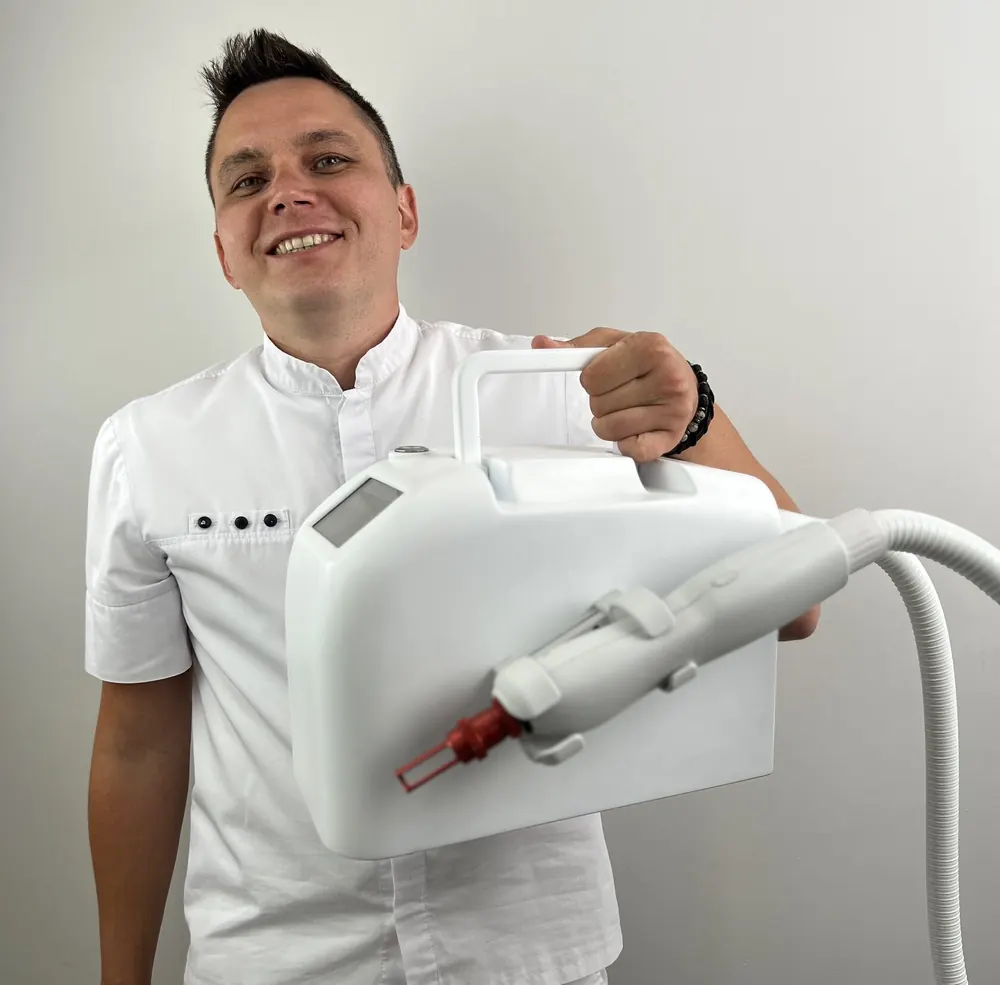

On the internet I have often come across conversations like these:
"Girls, what if I go over the client's eyebrows with the laser after the remover? Will that be OK?"
-
"Two removal methods in one session, isn't that too much stress for the skin?"
-
"I've combined them a hundred times, and my clients were happy in the end"
And so on.
You can rely on the experience of strangers and trust their advice, or you can figure out the question yourself with the help of this article! Only proven facts and logic here ;)
How are tattoos and PMU removed with a laser? And with a remover?
Let's start with laser removal. Its essence is breaking down pigment particles with an Nd:YAG laser. Ultra-short flashes penetrate the dermis and "shatter" the ink particles.
And we do not injure the skin in the process!
The obvious downside is that a laser does not remove all colours of PMU (permanent makeup) and tattoos.
Now it is the removers' turn. This is the name for a chemical formulation (acid-, salt- or alkali-based) that is introduced into the skin with a tattoo or PMU machine. The technique of removal with a remover is very similar to applying PMU or a tattoo.
A remover can remove pigments of any shade. But keep in mind that the risk of complications increases, because the skin is damaged when it is used!
Artists actively promote and use this removal method. For my part, I have nothing against it! But I believe the technique of removal with removers should be gentler on the skin than applying PMU.
Laser + remover = ...
Imagine that you have combined these two procedures into one session.
For example, you carried out laser removal of eyebrow PMU → the pigment broke down, swelling appeared → the local temperature rose → aseptic inflammation started.
And immediately afterwards you start working with a remover! That is, you damage the skin and introduce a chemical irritant → you intensify the reaction → you make the injury to that area of skin worse.
Expectation
- Boost the inflammatory reaction? That's great! It means the result will be even better!
Reality
- A stronger inflammatory reaction
- Skin regeneration fails
- Scars form
Or the second option: you used a remover, damaged the skin surface and triggered an inflammatory reaction. And then you decided to treat the area with the laser as well. By doing so, you cause greater damage and increase the inflammation and heating of the skin.
I believe this approach is excessive and risky. Severe skin damage without proven need or effectiveness.
I still advise following the rules that apply in medicine and science :)
If you can achieve a good result with the lowest risk, use that method. And as practice shows, the simplest way to reach a goal is the most effective.
How many sessions will it take?
A quick estimate on the Kirby-Desai scale — for tattoos.
10 sessions, approximately
A rough estimate. More on the Kirby-Desai scale page.
Frequently asked questions
Is saline or laser tattoo removal better?
Each has its trade-off. A Nd:YAG laser shatters pigment particles without injuring the skin but does not remove all colours of PMU and tattoos; a remover can remove pigments of any shade, but the risk of complications increases because the skin is damaged. If you can achieve a good result with the lowest risk, use that method.
Can you do laser and saline removal in the same session?
The author considers it excessive and risky: whichever method comes first, the second adds damage on top of inflammation that has already started, intensifying the reaction and the injury to the skin without proven need or effectiveness.
How does saline (remover) PMU removal work?
A remover is a chemical formulation (acid-, salt- or alkali-based) introduced into the skin with a tattoo or PMU machine. The technique is very similar to applying PMU or a tattoo, and the author believes it should be gentler on the skin than PMU application.