Can you get a tattoo or PMU if you have psoriasis?
Can you get a tattoo or PMU with psoriasis? It is not contagious or forbidden, but the Koebner phenomenon can trigger new patches at the treated site.

What is psoriasis? Can an artist catch it from a client?
Psoriasis is a chronic disease that affects the skin. The disease usually causes red, excessively dry spots called papules. They merge with each other and form plaques.
Psoriasis is not an infectious disease, so you cannot catch it!
I should note that it is a fairly common disease. More than 125 million people worldwide suffer from psoriasis. And many of those 125 million also want tattoos and PMU (permanent makeup).
This raises questions:
“Can I have eyebrow/lip PMU if there are no inflamed patches on my face?”
“How do you tattoo a client who has psoriasis?”
I could give the short answer “Yes, you can have a tattoo or PMU with psoriasis”, but that would only be 50% true. There is the Koebner phenomenon, which can trigger new areas of the skin disease!
The Koebner phenomenon: risks when doing PMU and tattoos
Briefly, the essence of this phenomenon: as a result of mechanical or chemical trauma, the disease can spread to healthy areas of skin.
Say a person has psoriasis. They decide to get a tattoo on the shoulder, since there is no inflammation there. After the mechanical damage to the tissue, the Koebner phenomenon kicks in and the skin disease spreads to the healthy skin of the shoulder.
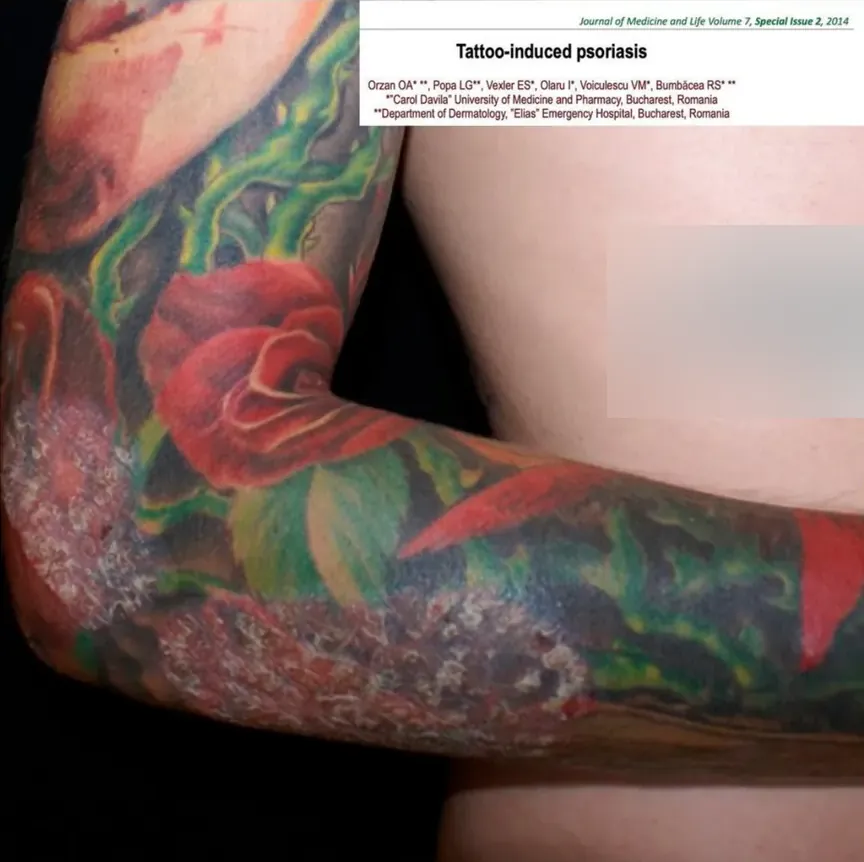
A psoriasis plaque — its appearance was triggered by the tattoo
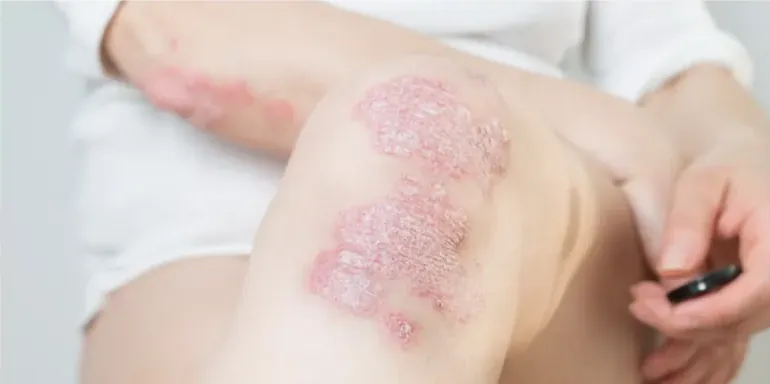
Plaques on the knee
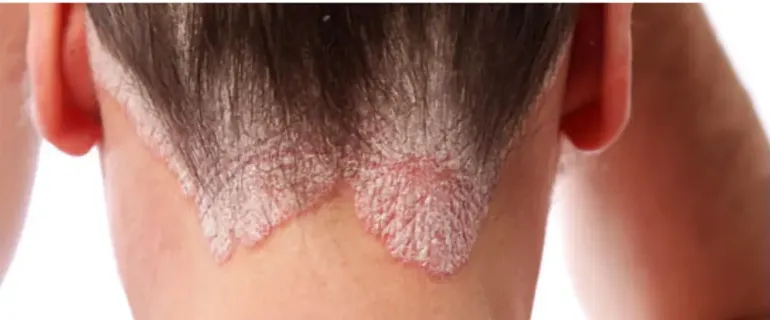
Plaques on the nape at the hairline
This is a rough outline of the mechanism, but I hope the idea is clear. When an artist works on a healthy area of skin with a tattoo machine, there is a small chance that over time the disease will affect that area too. A kind of “relapse” can occur.
So will I have to turn away clients with psoriasis?
Let me stress that tattoos and PMU are not prohibited for people with psoriasis. Just discuss this point with the client. Inform them of the risks and possible consequences, and tell them about the Koebner phenomenon.
If the client is informed, a negative experience after the procedure most likely won’t come as a shock to them!
My personal advice: during the consultation, don’t dodge the risks and be as honest as possible, so that you, the PMU and tattoo artist, aren’t the one blamed later for side effects or a disappointing result.
Frequently asked questions
Can you get PMU or a tattoo if you have psoriasis?
Tattoos and PMU are not prohibited for people with psoriasis, but there is a risk: through the Koebner phenomenon, the trauma of the procedure can spread the disease to the healthy skin being treated. Discuss this risk honestly with the client before the procedure.
Can a PMU artist catch psoriasis from a client?
No. Psoriasis is a chronic skin disease, not an infectious one, so you cannot catch it.
What is the Koebner phenomenon?
It is when, as a result of mechanical or chemical trauma, a skin disease such as psoriasis spreads to healthy areas of skin. After a tattoo or PMU there is a small chance that the disease will affect the treated area over time.