Tattoos and epidurals in labour: busting the myth
Can an epidural be given through a lower-back tattoo? Studies since 2002 show a healthy, healed tattoo is no reason to refuse an epidural in labour.
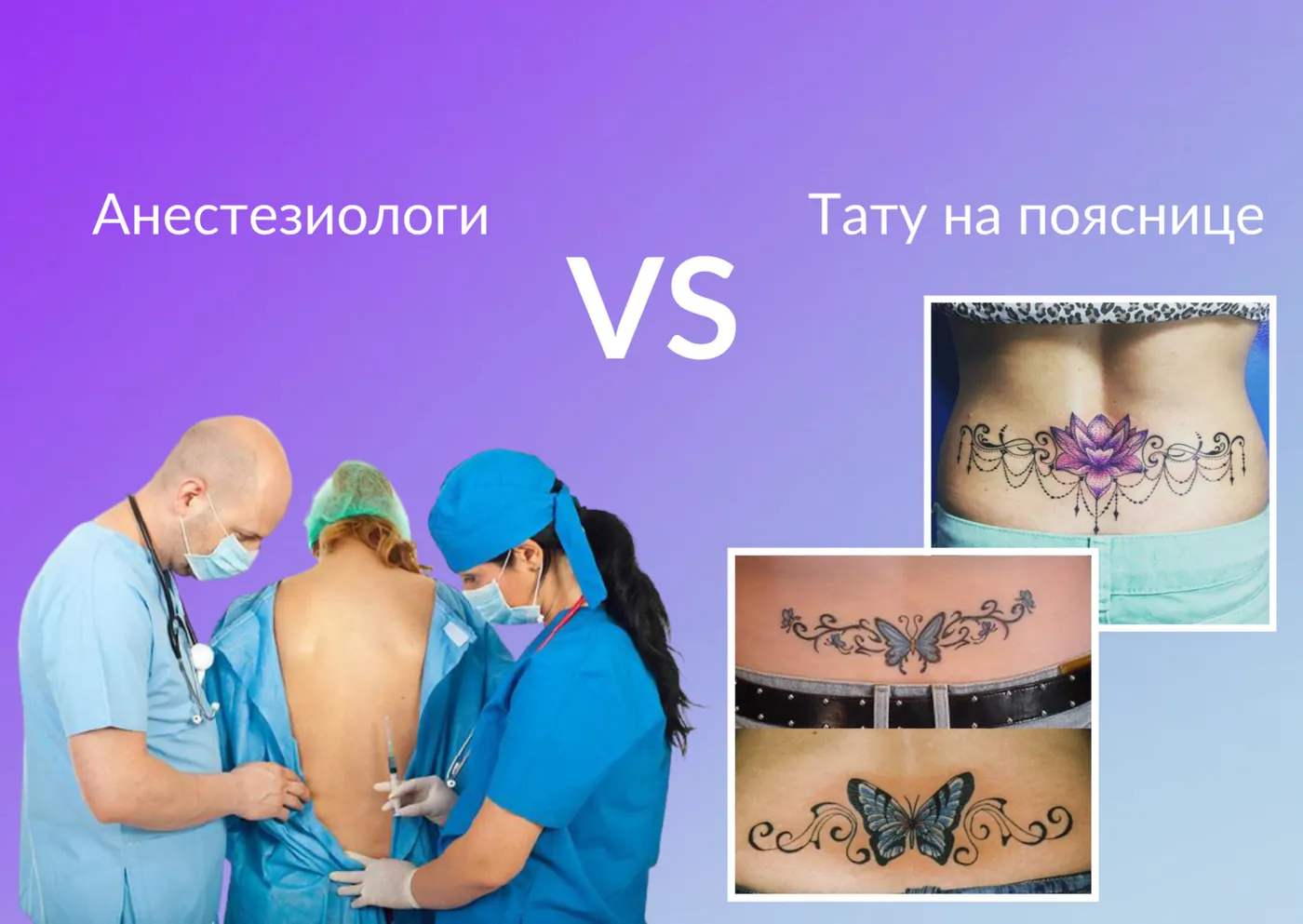
Today we have an important question on the agenda: can an epidural be performed in a tattooed area?
Even if you are not pregnant and not a doctor, read this article, because the topic is directly connected to people's health and to doctors' competence!
During childbirth it is especially important to weigh all the risks and make decisions objectively. Unfortunately, that does not always happen.
Now we will talk about a misconception that, without good reason, put a whole generation of women in labour under stress...
1. How it all started, and what tattoos have to do with it
Back in the early 2000s, the question was raised of whether epidural anaesthesia (hereafter EA) could be safely used in the area of a lower-back tattoo. The concern was one risk: pigment could get into the spinal canal along with the contents of the puncture needle.
This led to precautionary measures and to the opinion that EA should be ruled out for women in labour with a lower-back tattoo.
Epidural anaesthesia is a method of pain relief often used in childbirth. It removes sensation only in a specific area of the body.
In 2002, two Canadian anaesthesiologists, Douglas and Swenerton, published an article, "Epidural anesthesia in three parturients with lumbar tattoos: a review of possible implications". The study involved 3 women who had EA during labour.
I don't want to bombard you with confusing letters, so here is an image showing the different sections of the spine:
So, the first woman had a tattoo over the T12–S1 area and received two doses of EA at L2–L3.
The second woman's tattoo was at L4–L5, and she received a dose of EA in the L2–L3 space.
The third woman had a tattoo across her entire back, and the catheter for the EA was inserted through it.
None of the patients reported any complications.
Still, Douglas and Swenerton were concerned about the theoretical risk of pigment being carried from the tissues into the spinal cord when the needle was inserted. In that case, a potentially immunogenic tattoo pigment could cause inflammation of the membranes of the spinal cord and neurological complications.
But the authors were extremely cautious in their conclusions, writing that "we do not know" whether "inserting an epidural or spinal needle through a tattoo could trigger long-term problems".
2. A unique case of problems after EA
In response to that article, a Canadian anaesthesiologist reported the case of a 34-year-old woman in labour with a tattoo covering her whole lower back. A few hours after EA at L2–L3 she developed "burning" and "pain" without any skin inflammation.
The symptoms subsided within 24 hours without complications. The author suspected that the pigment-containing tissue from the tattoo was the cause of deeper irritation of the lumbar tissue.
Douglas and Swenerton replied that the soreness was most likely due to bruising from the insertion of the epidural needle, which was also seen in women without tattoos.
The report above remains the only "complication" ever recorded after EA through a tattoo.
Over time, the hype around this topic grew: on some internet forums, patients complained that they had been refused EA because of a lower-back tattoo.
In 2006, French anaesthesiologists published unofficial "recommendations" on how to perform EA when there is a tattoo on the lower back. They suggested:
-
trying to puncture outside the tattooed area, choosing a space above or below it;
-
using a lateral approach or choosing an untattooed spot within the tattoo;
-
making a small skin incision under local anaesthesia before inserting the needle into the tattooed area.
3. How tattooed skin is structured
Let me briefly explain how skin regenerates after a tattoo:
The pigment deposited in the epidermis after the procedure gradually thins out as the surface layers of tissue flake off. As a result of regeneration, the epidermis loses its pigment completely, so its presence in the "core" of this tissue is unlikely.
In the dermis, most of the pigment is taken up by macrophages, which migrate to the lymph nodes. The ink particles that stay behind are mainly intracellular: they sit inside those same macrophages and fibroblasts.
If the needle picks up these particles, the pigment will most likely be intracellular rather than free. Any epidermal cell touched by the needle during EA will definitely contain no pigment at all!
4. Is a skin incision needed for EA in a tattooed area?
Anaesthesiologists proposed the following: if there is no way to avoid the tattooed area, make an incision in the tattooed skin. However, there is no evidence that this reduces the likelihood of pigment getting into the contents of the puncture needle.
Moreover, tattoo pigment is located in the dermis. This means a proper incision has to go down to the subcutaneous fat. The anaesthesiologist must be absolutely sure of the incision site before inserting the spinal needle. If the incision is not deep enough, the risk of picking up pigment increases!
5. Statistics time! How have anaesthesiologists approached EA in a tattooed area?
Only a few rare studies have looked at the actual approaches and attitudes of anaesthesiologists to performing EA in women in labour with lower-back tattoos.
In a small British survey in 2007, Shanbhag and Chilvers found that 65% of anaesthesiologists would perform an epidural at the usual interspace even if there is a tattoo there. At the same time, almost half (45%) said that, given the choice, they would still try to avoid tattooed skin. In other words, most do not see a tattoo as an obstacle, but many habitually pick clear skin when it is available.
A larger Portuguese study of 162 anaesthesiologists showed the following results...
57%
of anaesthesiologists had already encountered this situation
60%
would prefer to perform EA on NON-tattooed skin
6%
of anaesthesiologists refused to perform EA through a tattooed area
Among those who had never encountered such a case, 74.3% of anaesthesiologists would perform EA in a woman with a lower-back tattoo. Of these, 67.2% would do it in an ink-free space and 7.1% would choose the tattooed area itself.
It is worth noting that this group's opinion was based on subjective judgement.
In 2008, 54 anaesthesiologists were surveyed in the French region of Languedoc-Roussillon. 57% of them would perform EA through the tattoo and 39% would refuse. The reasons for refusing included the risk of pigment "migration" (66%) and simple caution (43%), and only two-thirds of those who refused would offer the woman an alternative to EA.
Female anaesthesiologists more often expressed a negative opinion of tattoos than their male colleagues. They were also more likely to refuse EA for a woman in labour with a lower-back tattoo.
6. Great article! So what's the conclusion?
By 2020, 18 years after Douglas and Swenerton's article was published, no convincing complications had been found.
It is worth noting that lower-back tattoos are losing popularity: they are not as fashionable as they were 20 years ago. Today, young women giving birth are less likely to have such tattoos.
So, the verdict: if a lower-back tattoo is healthy and not inflamed, it should not worry obstetric anaesthesiologists, let alone prompt them to refuse EA during labour.
There are no risks in performing EA in the area of a healthy, fully healed tattoo!
Below I have attached the course of action when a woman in labour has a lower-back tattoo:
Can the tattoo area be avoided?
Avoid the tattoo
EA through the tattoo area (standard procedure, no skin incision)
Excellent! We have debunked another tattoo-related myth. You now understand how tattooed skin is structured and have added new knowledge to your expertise ;)
The arguments in this article are scientifically grounded and supported by research, and the material is based on the source "Tattoo and epidural analgesia: Rise and fall of a myth", Nicolas Kluger, Jean-Christian Sleth, Presse Med 49 (2020) 104050.
Frequently asked questions
Can you get an epidural with a lower-back tattoo?
Yes. By 2020, 18 years after the first article on the topic, no convincing complications had been found, and a healthy, fully healed tattoo that is not inflamed is no reason to refuse an epidural during labour.
Can tattoo ink get into the spinal canal during an epidural?
That was the theoretical concern raised in 2002. In healed skin the pigment sits in the dermis, mostly inside macrophages and fibroblasts, while the epidermis touched by the needle contains no pigment; the only reported complication, burning and pain, subsided within 24 hours.
Do anaesthesiologists refuse epidurals because of tattoos?
Some do. In a Portuguese study of 162 anaesthesiologists, 6% refused to perform an epidural through a tattooed area, and in a 2008 French survey of 54 anaesthesiologists, 57% would perform it through the tattoo and 39% would refuse.