Why are Nd:YAG lasers dangerous for your eyes?
How Nd:YAG lasers endanger the eyes: 400–1400 nm light harms the retina and skin reflects part of the beam. How to check safety glasses by wavelength and OD.
Everyone knows what a laser is, but only a few realise how dangerous it can be for a person. With alarming frequency I come across phrases like "Why bother with all that protective equipment? It's just a laser!" or "It's an ordinary beam, it isn't dangerous at all on its own!"
Indeed, it is just a class 4 laser, just severe burns, just serious injuries. What's the big deal?
I will never tire of repeating it: laser removal is by no means a simple job; it demands maximum responsibility from the specialist. The goal of today's article is precisely to make you aware of the possible risks of working with an Nd:YAG laser. As they say, forewarned is forearmed!
OK, how exactly can a laser cause harm?
Let's start with a brief overview of how a laser device works. First, it emits an electromagnetic wave of a certain length (for example, 532 or 1064 nm) that carries a certain amount of energy. The energy leaving the laser then penetrates tissue with ease. There it is converted into heat and acts on the inner layers of the skin.
Now imagine that this beam hits not the skin but the very delicate area of the eyes. Place your bets: what could the consequences be?
I'll say right away that they are far from pleasant. The human eye is very sensitive and can be damaged by lasers in the visible and near-infrared range. On top of that, the pulses generated by a laser will damage the eyes much faster than the blink reflex can kick in!
Visible and near-IR radiation (wavelengths from 400 to 1400 nm) is dangerous for the retina!
Another discouraging fact: you can injure your eyes not only through a direct hit from the laser beam but also through its reflection from glass or mirrored surfaces.
You can see this clearly in the diagram below:
From this we can draw the following conclusion...
The treatment room must not have any mirrored or exposed glass surfaces.
Another point is just as important: light also reflects from non-uniform (rough) surfaces! In this case, a parallel beam of light scatters after reflection, and the rays are reflected in different directions.
This phenomenon is called diffuse reflection, and it also has to be taken into account when working with a laser!
How does diffuse reflection work in laser removal?
When skin is irradiated with a laser, the beam of light is not fully absorbed by the skin, because a small part of it is always reflected! In this way, skin can reflect ≈ 5–7% of the light energy.
That is, when you treat the skin with a laser device, the beam is partly "thrown back" and hits other objects, including you!
You can immediately dismiss phrases like "What harm can a few percent do? It's very little and won't affect my health at all!" Believe me, it certainly will.
To illustrate, here is an example. Let's say we take an ordinary Nd:YAG laser with the most standard settings:
1,000 mJ
We set the energy to this value.
5 millimetres
We set the size of the laser beam.
10 nanoseconds
We set the pulse duration of the device.
A simple calculation shows that even with basic settings the peak power of the laser can reach 100,000,000 watts!
It follows that a seemingly tiny 5–7% in reality turns into 5–7 million (!) watts.
No, I am not exaggerating. And yes, this is scientifically confirmed information.
Surprised? Then here are some more figures. After recent studies on an 8-layer model of human skin, scientists concluded that a significant share of laser beam energy is reflected from it. And here we are talking not about 5 percent but about much higher numbers!
55.5%
of laser energy is reflected at a wavelength of 1064 nm
29.1%
is reflected at a wavelength of 532 nm
59.4%
is reflected from the skin at a wavelength of 755 nm
Makes you think, doesn't it? Laser removal no longer seems such a harmless and easy job. Let me stress it once again: during the procedure, always pay special attention to the eye area, which can easily be injured by powerful radiation.
Remember, a specialist always bears great responsibility, both to themselves and to the patient. You cannot act on the principle of "hopefully it'll be fine", because in medicine it is never fine, believe me. And a great deal is at stake, including your own health.
So how do you protect your eyes from laser radiation?
I think you already know the answer to this question ;)
With glasses, of course! The skin of our eyelids is very thin and does not protect the eye from the laser beam. That is why the eyes need special protective glasses designed for the parameters of the device being used.
Such glasses often come with the laser, but you must check them before use. You may get high-quality ones or just ordinary "sunglasses", so it is better not to take the risk.
To check your glasses for safety, you need to look at two main parameters: the wavelength and the OD value.
Check that the correct wavelength is marked on your glasses and that an OD value is given.
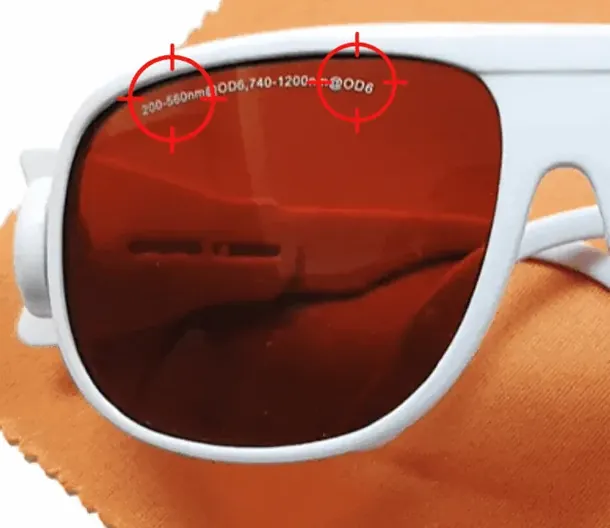
The OD value is stated and the wavelength is marked (there may be several ranges): 200–560 nm OD6, 740–1200 nm OD6
Frequently asked questions
Why are Nd:YAG lasers dangerous for the eyes?
Visible and near-infrared radiation (400–1400 nm) is dangerous for the retina, and laser pulses damage the eyes faster than the blink reflex can kick in. Injury can come from a direct hit or from a reflection off glass, mirrored or even rough surfaces.
How much laser light does skin reflect?
Skin always reflects part of the beam, about 5–7% of the light energy. In studies on an 8-layer model of human skin, 55.5% was reflected at 1064 nm, 29.1% at 532 nm and 59.4% at 755 nm.
How do you check laser safety glasses?
Look at two parameters: the correct wavelength must be marked on the glasses, and an OD value must be given. Glasses that come with the laser must also be checked before use.